“All bourbon is whiskey, but not all whiskey is bourbon.” Just as Champagne must originate in the Champagne region of France under strict appellation laws, bourbon is governed by rigorous federal statutes codified in the United States Code of Federal Regulations (27 CFR § 5.143). To carry the name bourbon, a spirit must meet six immutable criteria that separate it chemically, legally, and culturally from every other whiskey on earth.
Every year, millions of whiskey enthusiasts and travelers landing in Lexington, Kentucky ask the exact same question: “What makes bourbon different from regular whiskey?” While both spirits begin as a fermented mash of grains distilled into alcohol, bourbon represents the most tightly regulated spirit class in North America. Below is the comprehensive, legally grounded breakdown of what separates America’s Native Spirit from Scotch, Irish, Canadian, and standard American whiskies.
1. The 6 Non-Negotiable Federal Standards of Identity (27 CFR § 5.143)
Under United States federal law, enforced by the Alcohol and Tobacco Tax and Trade Bureau (TTB), a distilled spirit can only be labeled as Bourbon Whisky if it satisfies every single one of the following six statutory mandates:
Bourbon must be produced entirely within the United States. While 95% of the world’s bourbon is made in Kentucky, federal law allows production in any U.S. state. It cannot be made anywhere outside U.S. borders.
The fermented grain mash must contain at least 51% yellow dent corn (maize). The remaining 49% typically consists of malted barley and either rye (for spice) or wheat (for softness).
Distillation cannot exceed 160 proof (80% ABV). This ceiling ensures that flavorful congeners, grain oils, and aromatic esters from the corn and grains remain intact rather than stripped into neutral vodka spirit.
Before entering the barrel, the distillate must be cut with pure water to no higher than 125 proof (62.5% ABV). Lower entry proofs extract optimal water-soluble wood sugars (vanillin and caramel) from oak staves.
Bourbon must age in newly coopered, charred oak containers (virtually always American White Oak, Quercus alba). Used barrels (common in Scotch and Irish whiskey) are strictly forbidden.
No artificial color (e.g. caramel coloring E150a), flavoring, or neutral blending spirits may ever touch bourbon. Only water may be added to adjust bottling proof, which must be at least 80 proof (40% ABV).
2. Bourbon vs. Scotch vs. Rye vs. Irish Whiskey: Master Comparison
To truly appreciate bourbon, you must see how it compares against the world’s other major whiskey categories. While Scotch and Irish whiskies rely heavily on used bourbon casks and permit synthetic caramel coloring, American bourbon draws 100% of its color and over 60% of its flavor directly from fresh charred wood.
| Spirit Type | Primary Grain Mash | Barrel Requirements | Minimum Aging | Caramel Color (E150a) |
|---|---|---|---|---|
| Kentucky Bourbon | Min. 51% Corn (plus rye/wheat & malt) | New Charred Oak Only | No min. (2 yrs for “Straight”) | ILLEGAL (0%) |
| Single Malt Scotch | 100% Malted Barley | Used Oak Casks (ex-Bourbon/Sherry) | 3 Years in Scotland | Permitted |
| American Rye Whiskey | Min. 51% Rye Grain | New Charred Oak Only | No min. (2 yrs for “Straight”) | ILLEGAL (0%) |
| Tennessee Whiskey | Min. 51% Corn (Bourbon Mash) | New Charred Oak (Lincoln County Process) | No min. (2 yrs for “Straight”) | ILLEGAL (0%) |
| Irish Whiskey | Malted & Unmalted Barley, Grains | Used Wood Barrels (Bourbon/Sherry) | 3 Years in Ireland | Permitted |
3. The Secret Weapon: Kentucky’s Limestone Karst Aquifer
— Kentucky Distillers’ Association & Commonwealth Gubernatorial Slogan
While federal law permits bourbon to be distilled anywhere in the United States, Kentucky produces 95% of the global supply. That dominance is grounded in the unique geology of Central Kentucky’s ancient subterranean Ordovician limestone shelf.
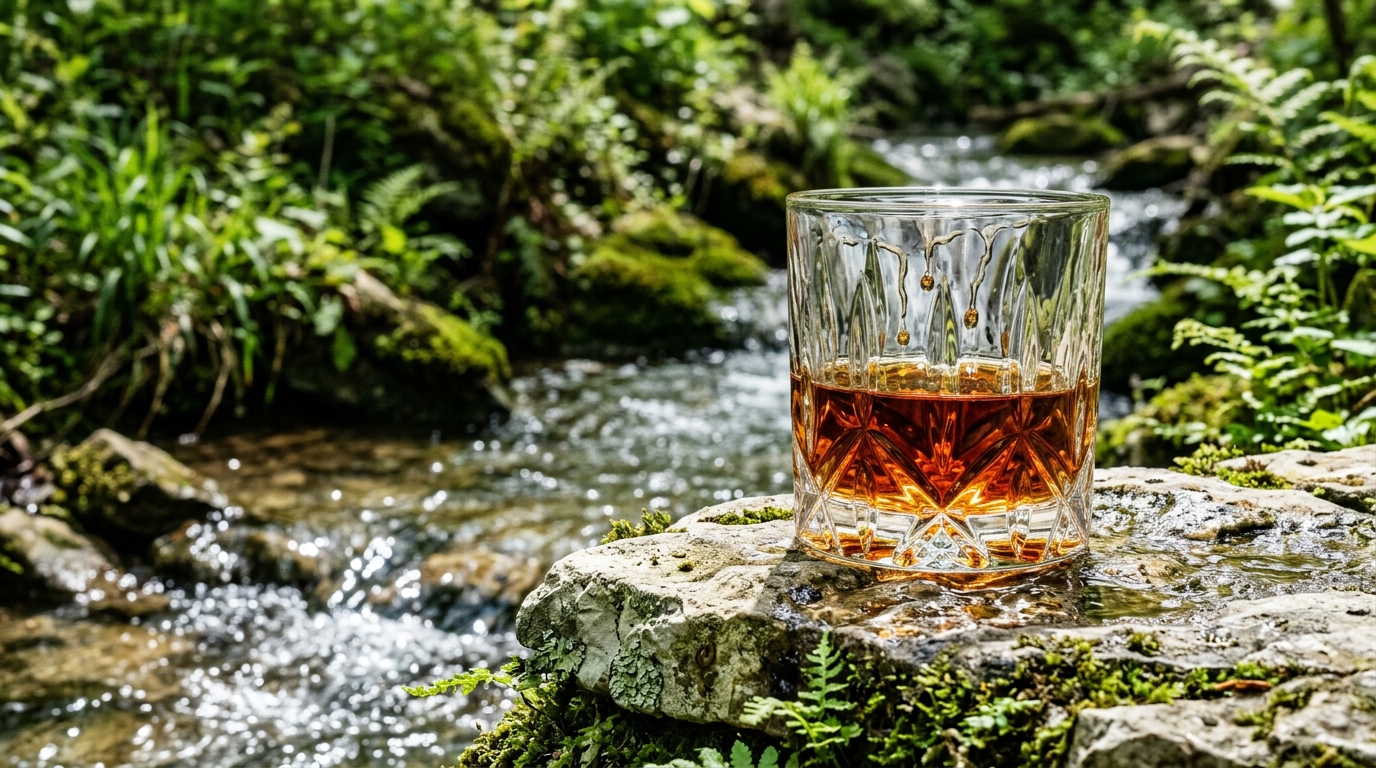
Central Kentucky sits atop an ancient subterranean Ordovician limestone shelf. As groundwater percolates through hundreds of feet of natural limestone karst, two critical chemical reactions take place:
- Iron Elimination: Iron is the mortal enemy of whiskey. Even microscopic trace amounts of iron react with oak tannins to turn distillate pitch-black and impart an acrid, bitter metallic taste. Kentucky limestone naturally precipitates 100% of iron out of the water.
- Calcium & Magnesium Enrichment: Limestone dissolves rich minerals—predominantly calcium and magnesium carbonate—into the spring water. These minerals act as vital nutrients for yeast cultures during fermentation, creating silky, sweet mash that ferments vigorously and cleanly.
- Thermal Expansion in Rickhouses: Kentucky’s dramatic four-season continental climate swings from 15°F in winter to 98°F with heavy humidity in summer. This pressure forces the expanding bourbon deep into the porous oak staves, pulling out lignin, vanillin, and wood sugars before contracting during colder months.
4. The Three Major Bourbon Mashbill Archetypes
While corn must comprise at least 51% of the grain recipe, the remaining grains define the flavor profile on your palate:
Traditional Bourbon Mashbill
70-80% Corn • 10-15% Rye • 10-12% Malted Barley
Balanced profile offering caramel, toasted vanilla, and a gentle peppery rye snap. Benchmark examples include Jim Beam, Buffalo Trace, and Wild Turkey.
Wheated Bourbon Mashbill
70-80% Corn • 15-20% Wheat • 10% Malted Barley
Replaces spicy rye with soft winter wheat for a rounder, creamier, sweeter profile with notes of honey, stone fruit, and brioche. Benchmark examples: Maker’s Mark, Pappy Van Winkle, and Weller.
High-Rye Bourbon Mashbill
55-65% Corn • 20-35% Rye • 10% Malted Barley
Robust, pungent, and bold. Delivers intense cracked black pepper, mint, baking spice, and clove. Benchmark examples: Bulleit Bourbon, Four Roses Single Barrel, and Woodford Reserve.
5. Where to Experience the Difference in Lexington, KY
Lexington is the geographic heartbeat of Bourbon Country. You can walk straight from your downtown hotel to working heritage distilleries and world-class tasting rooms:
- James E. Pepper Distillery (DSP-KY-5): Tour the legendary 1879 Manchester Street stillhouse where Colonel Pepper made the Old Fashioned cocktail famous, featuring Vendome copper stills, limestone well water, and 1776 high-rye whiskeys. Read our complete James E. Pepper visitor & tour guide.
- The Lexington Distillery District: Explore Manchester Street’s historic 25-acre Pepper Campus, complete with live concerts at The Burl, wood-fired pizza at Goodfellas & Wiseguy Lounge, and craft scoops at Crank & Boom. Read the Manchester Street insider guide.
- The Lexington Bourbon Trail Itinerary: Pair downtown distilleries (Pepper, Town Branch, RD1) with iconic countryside estates (Woodford Reserve, Castle & Key, Buffalo Trace) in our 3-Day Bluegrass spirits roadmap.
- The Full Lexington Bourbon Hub: Explore our interactive map of all 18+ Central Kentucky distilleries, tasting bars, and cocktail lounges in our Lexington Bourbon Directory.
People Also Ask: Bourbon vs. Whiskey Essentials
Does bourbon have to be made in Kentucky?
No. Federal law allows bourbon to be produced anywhere in the United States. However, Kentucky produces approximately 95% of the global supply due to its iron-free limestone water, rich agricultural soils, and generational distilling craftsmanship. Only bourbon distilled and aged in Kentucky can carry the legal label “Kentucky Straight Bourbon.” Learn more in our Rules of Bourbon Legal Guide.
What is the difference between bourbon and rye whiskey?
The primary difference lies in the grain mashbill: bourbon must contain at least 51% corn (producing a sweet, rich, round flavor with vanilla and caramel), whereas American rye whiskey must contain at least 51% rye grain (producing a dry, spicy, peppery, and herbal profile). Both must age in newly charred oak containers.
What is the difference between bourbon and Tennessee whiskey?
Tennessee whiskey meets all legal requirements of bourbon, but undergoes one extra step prior to barreling: the Lincoln County Process. Distillate is slowly dripped through 10-foot vats of sugar maple charcoal to filter out heavy oils before entering charred oak barrels. Tennessee state law legally defines this distinction.
Why is iron bad for bourbon?
Iron chemically reacts with natural wood tannins extracted from charred oak barrels, turning the clear distillate into an unappealing inky black liquid and imparting a harsh, bitter metallic taste. Kentucky’s natural karst limestone acts as a natural geological filter that precipitates out 100% of iron from groundwater.
Can you add color or flavoring to bourbon?
Absolutely not. Federal law (27 CFR § 5.143) strictly forbids any artificial coloring, flavoring, or blending additives in bourbon. 100% of its deep amber color and complex flavor must come exclusively from the charred oak barrel staves and fermented grains.
Central Kentucky Bourbon Authority Series
Pillar Knowledge Graph
Explore our comprehensive, interlinked knowledge series on Kentucky’s native spirit—from federal legal standards and karst limestone chemistry to Lexington’s historic Manchester Street stillhouses and regional trail itineraries:
Bourbon vs. Whiskey: The Definitive Rules
Chemical terroir, mashbills, and the science of limestone karst water.
The 6 Rules of Bourbon (27 CFR § 5.143)
The legal taxonomy, Bottled-in-Bond Act, and DSP permits.
James E. Pepper Distillery (DSP-KY-5)
1879 Manchester St history, the Old Fashioned, and copper still tours.
Lexington Distillery District
The Burl, Goodfellas Pizza, Crank & Boom, and craft nightlife.
Lexington Bourbon Trail Roadmap
Connecting urban craft stills to Woodford Reserve and Castle & Key.