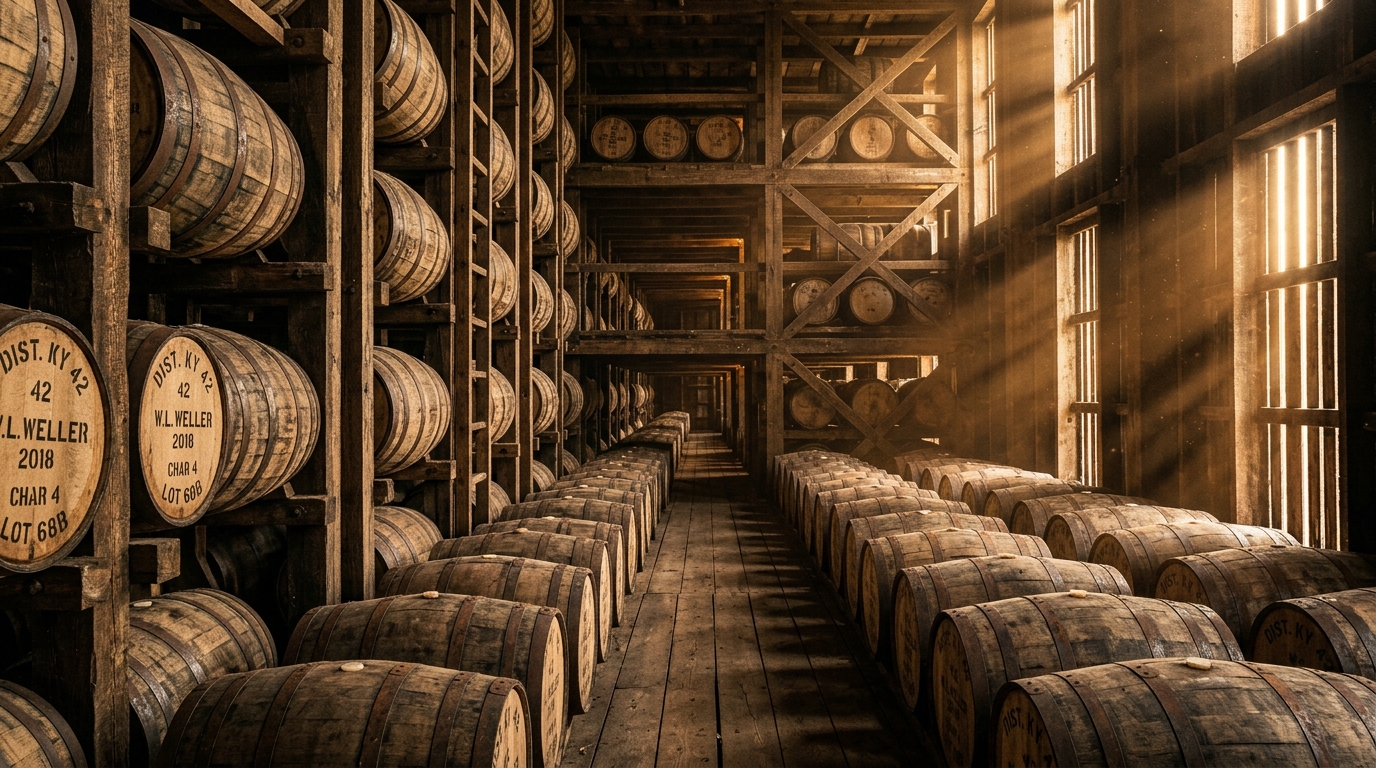
On May 4, 1964, the 88th United States Congress passed Senate Concurrent Resolution 19 (78 Stat. 1208), officially recognizing Bourbon Whisky as a “distinctive product of the United States.” Unlike Scotch or Cognac, which are protected by foreign crowns, bourbon is protected by federal statute. Every bottle must comply with the Standards of Identity set forth in Title 27 of the Code of Federal Regulations.
Behind every pour of Kentucky bourbon stands more than two centuries of legal precedent, tax law, and agricultural protectionism. From the Whiskey Rebellion of 1791 to the landmark Bottled-in-Bond Act of 1897 and modern TTB regulations, these rules ensure that when you purchase a bottle of bourbon, you are drinking pure, unaltered liquid craftsmanship. Here is the definitive legal guide to the six statutory rules of bourbon.
The 6 Immutable Statutory Rules of Bourbon (27 CFR § 5.143)
1
Geographic Boundary: Produced in the United States
By law, bourbon cannot be distilled in Canada, Scotland, Japan, Ireland, or Mexico. Under international trade agreements and NAFTA/USMCA, other nations recognize bourbon as an exclusively American spirit. A distiller in Germany using 70% corn and new charred oak cannot legally sell their spirit as “bourbon” in international commerce.
While federal statute permits bourbon to be crafted anywhere across the United States, Kentucky’s delegation placed the Commonwealth’s stance on the national record during the 2016 convention roll call, introducing Kentucky as “the state that produces all the bourbon fit to drink in the world.”
2
Grain Mashbill: Minimum 51% Corn
Corn provides bourbon with its hallmark body, rich oily texture, and sweet foundation. The remaining 49% of the mashbill consists of “small grains”—rye for peppery herbaceousness, wheat for softness and bread crust, and malted barley, whose natural alpha and beta amylase enzymes convert complex grain starches into fermentable sugars.
3
Distillation Ceiling: Maximum 160 Proof (80% ABV)
Vodka is distilled at 190 proof or higher, stripping out virtually all grain flavor and character. By capping bourbon distillation at 160 proof (with most Kentucky distillers coming off the beer still and doubler between 130 and 140 proof), federal law preserves the volatile flavor compounds (esters, aldehydes, and higher alcohols known as congeners) that give bourbon its agricultural terroir.
4
Barrel Entry Ceiling: Maximum 125 Proof (62.5% ABV)
High-proof alcohol dissolves harsh wood tannins. By forcing distillers to dilute raw spirit down to 125 proof or lower before filling barrels, the water enables sweet wood sugars (hemicellulose, vanillin, and caramel) to dissolve into the liquid during maturation. Brands like Maker’s Mark enter the barrel at a super-low 110 proof to maximize sweetness.
5
Aging Vessel: New, Charred Oak Containers
The barrel must be new and it must be charred on the inside with open flame (typically Level 3 char of 35 seconds or Level 4 “alligator” char of 55 seconds). The char creates a natural activated carbon filter that removes sulfur and harsh compounds while caramelizing the wood’s natural sugars. Once a barrel is emptied, it can never be used to make bourbon again (used barrels are shipped to Scotland, Ireland, or Mexico for tequila).
6
Bottling Floor: Minimum 80 Proof & Zero Additives
Bourbon must be bottled at a minimum of 80 proof (40% ABV). Absolutely zero caramel coloring, sugar, oak flavoring, or blending additives may be introduced. The only permissible addition is pure water to reduce proof.
Special Legal Designations: Straight Bourbon & Bottled-in-Bond
“Straight” Bourbon Requirements
- Must be aged in new charred oak for a minimum of 2 full years.
- If aged for less than 4 years, the bottle must carry an explicit age statement (e.g., “Aged 36 Months”).
- If aged 4 years or longer, an age statement is optional.
- Must not contain any added color or flavorings.
The Bottled-in-Bond Act of 1897
Championed by Col. Edmund Haynes Taylor Jr., this was America’s first major consumer protection law, predating the Pure Food and Drug Act of 1906:
- Produced in a single distillation season (Spring or Fall) by one master distiller.
- Distilled at a single distillery (DSP).
- Aged for at least 4 years in a federally bonded government warehouse.
- Bottled at exactly 100 proof (50% ABV).
Lexington’s Role in Bourbon History & Distilled Spirits Plants (DSP)
Long before modern cocktail bars filled downtown Lexington, Old Bourbon County extended across Central Kentucky. The city’s Town Branch waterway was home to dozens of historic copper pot distilleries in the 1800s. Under federal law, every legally registered distillery in the United States is assigned a Distilled Spirits Plant (DSP) permit number by the TTB.
Lexington holds some of the most prestigious early permit numbers in American history:
- James E. Pepper Distillery (DSP-KY-5): The 5th federal distillery permit ever registered in Kentucky. Founded in 1780 and rebuilt on Manchester Street in 1879, Colonel James E. Pepper championed the federal Bottled-in-Bond Act of 1897 and made the Old Fashioned cocktail famous. Read our complete James E. Pepper DSP-KY-5 tour guide.
- The Distillery District (Manchester Street): The historic 25-acre Pepper rickhouse campus has been transformed into a national model for industrial preservation, pairing stillhouse tours with Goodfellas Pizza, The Burl, and Crank & Boom.
- Bourbon vs. Whiskey: The Science: How Kentucky’s subterranean limestone karst aquifer removes 100% of iron while infusing calcium and magnesium. Read our chemical terroir and mashbill breakdown.
- The 3-Day Bluegrass Spirits Roadmap: Connect Lexington’s urban distillers (Pepper, Town Branch, RD1) with historic country estates (Woodford Reserve, Castle & Key, Buffalo Trace) in our Lexington Bourbon Trail Itinerary.
People Also Ask: Legal Standards & Bourbon Law
What is the minimum age required for standard bourbon?
Legally, there is no minimum aging requirement for basic “bourbon”—a spirit that touches a new charred oak barrel for five seconds technically qualifies. However, to earn the coveted designation “Straight Bourbon,” it must age for at least two full years. Any straight bourbon aged less than four years must explicitly disclose its youngest component on the label.
Why can’t bourbon barrels be reused for bourbon?
Federal law explicitly mandates “new charred oak containers.” Once a barrel has held whiskey, it has yielded the majority of its soluble wood sugars, vanillin, and fresh charcoal layer. Reusing it would result in a lighter, Scotch-style spirit rather than the rich, full-bodied amber profile required of American bourbon.
What does DSP stand for on a bourbon bottle?
DSP stands for “Distilled Spirits Plant,” the federal permit number assigned by the TTB to an authorized distillery. For example, Lexington’s historic James E. Pepper Distillery holds the legendary permit DSP-KY-5, one of the earliest numbered distilleries in American history.
What is the Bottled-in-Bond Act of 1897?
Passed by Congress in 1897 to protect consumers from adulterated rotgut whiskey, the Bottled-in-Bond Act created the nation’s first consumer protection standard. To be labeled “Bottled-in-Bond,” the whiskey must be distilled at a single distillery (DSP) by one distiller during a single season (spring or fall), aged for at least 4 years in a federally bonded warehouse, and bottled at exactly 100 proof (50% ABV).
Can a master distiller add caramel coloring to bourbon?
No. Unlike Scotch, Canadian whisky, or dark rum, federal standards (27 CFR § 5.143) prohibit the addition of caramel coloring (E150a) or any synthetic dyes. 100% of bourbon’s color must be extracted naturally from the charred oak staves during maturation.
Central Kentucky Bourbon Authority Series
Pillar Knowledge Graph
Explore our comprehensive, interlinked knowledge series on Kentucky’s native spirit—from federal legal standards and karst limestone chemistry to Lexington’s historic Manchester Street stillhouses and regional trail itineraries:
Foundational Science
Bourbon vs. Whiskey: The Definitive Rules
Chemical terroir, mashbills, and the science of limestone karst water.
The 6 Rules of Bourbon (27 CFR § 5.143)
The legal taxonomy, Bottled-in-Bond Act, and DSP permits.
James E. Pepper Distillery (DSP-KY-5)
1879 Manchester St history, the Old Fashioned, and copper still tours.
Lexington Distillery District
The Burl, Goodfellas Pizza, Crank & Boom, and craft nightlife.
Lexington Bourbon Trail Roadmap
Connecting urban craft stills to Woodford Reserve and Castle & Key.
SEARCH INTELLIGENCE & FREQUENTLY ASKED QUESTIONS
Verified Frequently Asked Questions
What are the rules for bourbon?
By federal Standards of Identity (27 CFR § 5.143), Kentucky straight bourbon must be produced in the United States from a grain mash of at least 51% corn, distilled to no more than 160 proof (80% ABV), entered into new charred oak containers at no more than 125 proof (62.5% ABV), and contain no added flavoring, coloring, or blending agents.
- To carry the designation “Straight Bourbon”, it must be aged for a minimum of 2 continuous years in new charred oak.
- If aged less than 4 years, an age statement must be explicitly printed on the label.