Gainesway Farm • 3750 Paris Pike, Lexington, KY
The Backstory: Before the Breeders’ Cup existed, American horse racing vanished from national television the moment the Belmont Stakes concluded in early June, leaving year-end Eclipse Award championships to be decided by contentious writer ballots rather than head-to-head confrontation. On April 23, 1982, Lexington visionary John R. Gaines of Gainesway Farm proposed a bold solution: a breeder-financed, single-day $10 million autumn championship broadcast live on NBC. Within 30 months, Gaines and Hall of Fame horseman John Nerud turned that speech into the historic November 10, 1984 inaugural Breeders’ Cup.
Planning a trip to Lexington or looking up Keeneland championship history? Browse our 8-part guide covering the founding story at Gainesway Farm, all 55 Grade 1 winners across Keeneland’s four host editions (2015, 2020, 2022, 2026), the $100M+ Paddock Building expansion, parking and shuttle tips, track handicapping, and Kentucky horse farm tours:
1. John R. Gaines & the Commercial Revolution at Gainesway Farm
Born in Lexington in 1928 into a family deeply rooted in Standardbred harness racing (his father, Clarence F. Gaines, invented Gaines Dog Meal and founded the Gainesway Standardbred nursery), John Ryan Gaines transformed Gainesway Farm along historic Paris Pike into one of the most influential Thoroughbred stallion stations on earth during the 1960s and 1970s.
Gaines pioneered the modern commercial stallion syndication model—assembling up to 40 fractional shares in elite European and American turf and dirt champions so breeders could diversify risk while standing forty or more stallions on a single farm. At Gainesway, he stood a pantheon of global bloodstock titans including Arc de Triomphe winner Vaguely Noble, French champion Blushing Groom (FR), classic miler Riverman, and Northern Dancer’s son Lyphard.
2. The April 23, 1982 Manifesto: Shocking the Kentucky Establishment
By early 1982, despite soaring yearling prices at the Keeneland July Selected Sales, Gaines recognized a dangerous structural flaw in Thoroughbred racing. While the NFL had the Super Bowl and Major League Baseball had the World Series, horse racing lacked an autumn climax. Regional stars stayed in New York, California, or Europe without facing one another, and television networks ignored the sport for ten months of the year.
Invited to deliver the keynote address at the Kentucky Derby Festival’s annual “They’re Off!” Luncheon on April 23, 1982, in Louisville, Gaines kept his text secret from everyone—including his own family and board colleagues. Standing before a crowd expecting polite Bluegrass nostalgia, Gaines delivered a thunderbolt manifesto calling on the industry to fund its own salvation:
- The Stallion & Foal Nomination Engine: Every participating stallion owner in North America would contribute the equivalent of one advertised stud fee per year to make that sire’s progeny eligible, while foal owners would pay a nominal single nomination fee ($500) in the foal’s birth year.
- A $10 Million Single-Day Championship Card: Seven Grade 1 divisional championship races contested on a single afternoon—Juvenile, Juvenile Fillies, Sprint, Mile (Turf), Distaff, Turf (1 ½ miles), and a record-shattering $3 million Breeders’ Cup Classic.
- Rotating Host Tracks & Network Television: Rather than locking the event to one track, the Breeders’ Cup would rotate across North America’s premier racetracks during a four-hour live broadcast on NBC Sports.
Horse racing must unite around a single, year-end championship festival funded by the breeders themselves—a global stage where every division is settled on the racetrack, not merely by ballot.
Founder of the Breeders’ Cup • Master of Gainesway Farm (Paris Pike, Lexington, KY) • April 23, 1982 Manifesto
1982 Founding Vision
3. Overcoming Skepticism: The Gaines–Nerud Alliance & November 10, 1984
Traditional racetrack executives in New York and Kentucky initially resisted the proposal, fearing a late-autumn championship would cannibalize their established fall stakes cards (such as Belmont’s Jockey Club Gold Cup or Laurel’s Washington, D.C. International). To bridge the divide between aristocratic Bluegrass breeders and hard-bitten racetrack operators, Gaines partnered with legendary Hall of Fame trainer and Tartan Farms president John Nerud, who became Chairman of the Breeders’ Cup Marketing Committee.
Together with NBC Sports executive producer Michael Weisman and Marje Everett of Hollywood Park, they launched the Inaugural Breeders’ Cup on November 10, 1984, in Inglewood, California, before 64,254 fans:
| 1984 Inaugural Race | Purse | Inaugural Champion | Jockey / Trainer | Historical Significance |
|---|---|---|---|---|
| Breeders’ Cup Juvenile (G1) | $1,000,000 | Chief’s Crown | Don MacBeth / Roger Laurin | First-ever Breeders’ Cup race winner; Danzig colt |
| Juvenile Fillies (G1) | $1,000,000 | Outstandingly | Walter Guerra / Pancho Martin | Awarded via disqualification of Fran’s Valentine |
| Breeders’ Cup Sprint (G1) | $1,000,000 | Eillo | Craig Perret / Budd Lepman | Wire-to-wire speed clinic in 1:08.20 |
| Breeders’ Cup Mile (G1) | $1,000,000 | Royal Heroine (IRE) | Fernando Toro / John Gosden | North American record 1:32.60; first European-bred winner |
| Breeders’ Cup Distaff (G1) | $1,000,000 | Princess Rooney | Eddie Delahoussaye / Neil Drysdale | Crushed unbeaten Life’s Magic by 7 lengths |
| Breeders’ Cup Turf (G1) | $2,000,000 | Lashkari (GB) | Yves Saint-Martin / Alain de Royer-Dupré | 53-1 upset for His Highness the Aga Khan over All Along |
| Breeders’ Cup Classic (G1) | $3,000,000 | Wild Again (31-1) | Pat Day / Vincent Timphony | Immortal 3-horse stretch war over Slew o’ Gold & Gate Dancer |
4. Why Keeneland Waited 31 Years to Host (1984–2015) & the Homecoming
For three decades after 1984, even though Breeders’ Cup Limited was headquartered in Lexington, Kentucky, and funded overwhelmingly by Fayette, Woodford, and Bourbon County stallion farms, the event bypassed Keeneland in favor of massive urban stadiums like Churchill Downs, Belmont Park, and Santa Anita. Two factors delayed Keeneland’s debut:
- The Boutique Seating Paradigm Shift: Until the early 2010s, the Breeders’ Cup chased raw 70,000+ general admission attendance numbers. Keeneland President Bill Thomason and Breeders’ Cup CEO Craig Fravel pioneered the “Boutique Temporary Chalet Model”—recognizing that capping attendance around 43,000–45,000 while building multi-story trackside luxury chalets generated higher hospitality revenue and an unmatched viewer atmosphere.
- The 2014 Return to Conventional Dirt: From Fall 2006 through Spring 2014, Keeneland raced over a synthetic Polytrack main surface. In the summer of 2014, Keeneland excavated the Polytrack and installed a state-of-the-art conventional Kentucky limestone-sand-clay dirt surface—immediately unlocking the 2015 Breeders’ Cup award and setting the stage for American Pharoah’s 2015 Grand Slam.
- The Definitive Keeneland Fall Meet Guide: Tickets, Post Times, Tailgating on “The Hill” & Paddock Traditions
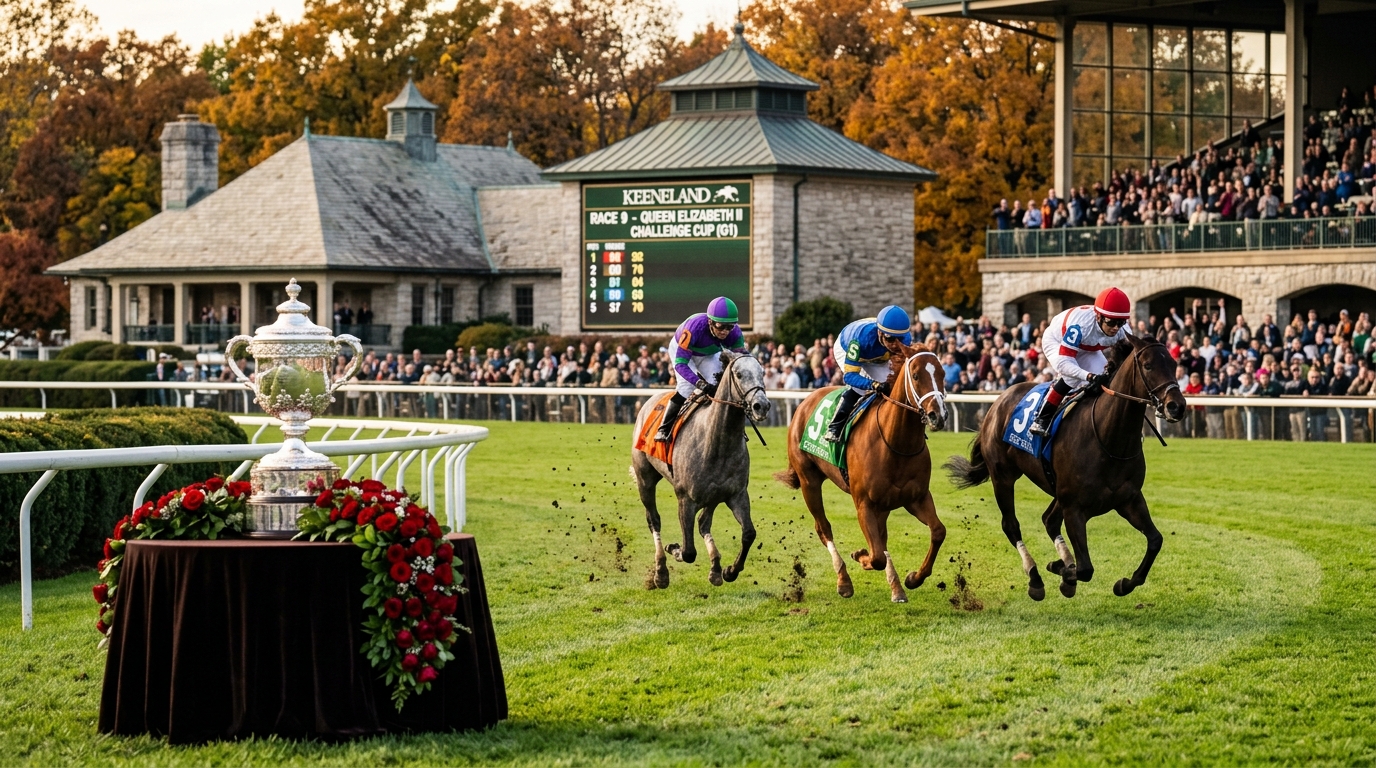
- The Queen Elizabeth II Challenge Cup at Keeneland: Royal History & Turf Stakes Analysis
- How to Bet at Keeneland: Pari-Mutuel Fundamentals & 15% Pick 5 Takeout Guide
- Sunrise Trackside & The Track Kitchen: Keeneland’s Morning Workout & Breakfast Ritual
- The Ultimate Lexington Bourbon Trail Itinerary: 3-Day Bluegrass Spirits Roadmap